From the reading desk
Semaglutide in STEP: reading a pooled result
A scientific reading companion on counting people, defining the population and interpreting a combined estimate.
Clinician medical review has not been completed.
What does a pooled result represent?
STEP-1–3 studied adults with overweight or obesity for 68 weeks; STEP-2 included type 2 diabetes, while STEP-3 added intensive behavioral therapy.[1]
A pooled number needs an answer to a question that comes before arithmetic: whose experience should the number describe? Gathering every available record defines a collection. It does not, by itself, explain why that particular mixture is the population of interest. The distinction matters whenever a summary will be carried beyond the records that produced it. A reader needs to know both what was assembled and what the resulting estimate is meant to represent.
Imagine the question stated without any treatment names: among people meeting a specified set of conditions, how often was a defined outcome recorded under each alternative? That sentence contains several choices. Changing the conditions changes who belongs. Changing the outcome changes what is counted. Changing the alternatives changes the comparison. Combining studies is useful only in relation to such a question; the act of combining cannot choose the question for us.
A larger collection can contain more information while remaining unsuitable for a particular comparison. This is not a contradiction. Quantity concerns how much information is available; relevance concerns whether that information addresses the intended target. If a proposed conclusion concerns a different mixture of people or circumstances, the argument must explain the move between them. Adding records does not remove that obligation, even when the resulting estimate looks precise.
The useful starting point is therefore a sentence defining the target, followed by a description of how the contributing records connect to it. This separates a question about summarizing the assembled evidence from a question about applying it elsewhere. Both may be worthwhile, but they require different justification.
Read a count before a percentage
Pooled safety N=2116/1261; randomized N=2117/1262 (semaglutide/placebo).[2]
A denominator is a membership statement. It names the set within which a numerator should be interpreted. Before dividing, ask whether every counted outcome belongs to someone eligible for that denominator under the same rule. A mathematically correct division can still answer the wrong question if its parts describe different sets. Agreement in treatment name or table heading is not enough to establish that the sets match.
For a participant percentage, the numerator must count participants meeting the stated criterion, rather than every occurrence recorded for those participants. The denominator must identify the eligible people. Neither a count of assignments nor a count of completed measurements automatically supplies the other. Those are different kinds of record, and their usefulness depends on the outcome being summarized. The label attached to each count is part of its meaning.
An exact count can also coexist with uncertainty about the broader phenomenon. Counting the members of a defined set is different from estimating how often an outcome would occur in a target population. A clear display of the first does not supply the second. This distinction prevents visual size from acquiring a meaning it has not earned: a longer bar can be read accurately without treating length as an estimate of benefit or harm.
When two analysis totals differ, the productive next step is to inspect the membership rules and trace how records enter each set. The discrepancy alone does not identify a cause or an error. Conversely, equal totals would not prove identical membership: different selections can have the same size. An audit of inclusion rules therefore answers something that a comparison of totals, however careful, cannot settle.
Reading the counts
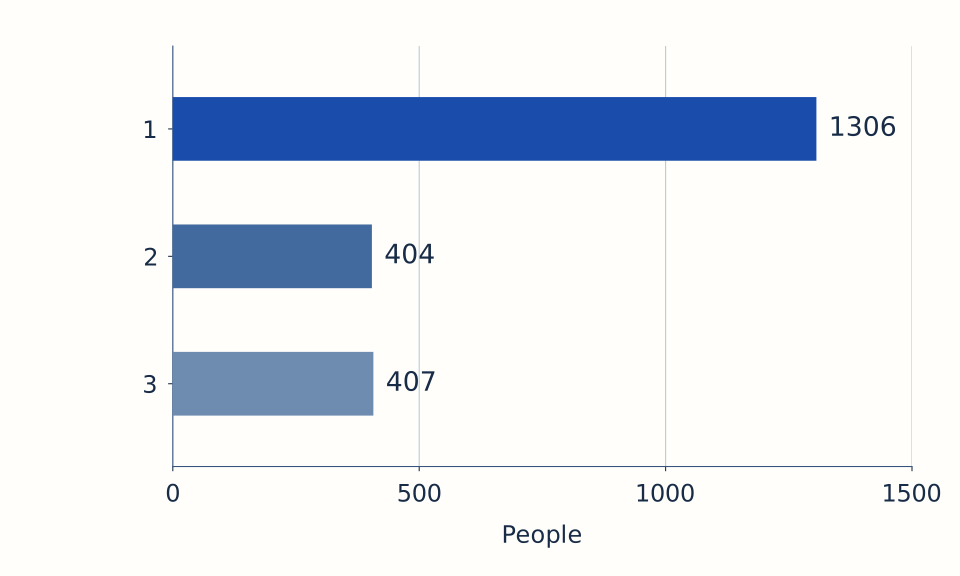
Open the chart’s data table
| Trial | People |
|---|---|
| 1 | 1306 |
| 2 | 404 |
| 3 | 407 |
How a weight changes the question
Post-hoc pooled adverse-event percentages used trial-stratified weighting.[2]
There is more than one way to turn several summaries into one. Adding eligible participant records gives people equal counting weight within that construction. Averaging study percentages equally gives studies equal weight, irrespective of their sizes. Choosing another weighting rule gives contributions according to that rule. These operations need not produce the same result because they preserve different relationships between the component information and the final summary.
To understand this without guessing any actual weights, hold the component percentages fixed and consider changing how much each contributes. If the percentages differ, increasing one contribution moves the combined value toward that component. Nothing about the underlying component observations has to change. The change is in the mixture represented by the summary. That is why explaining a weighting rule is part of explaining the estimate, rather than an optional technical detail.
The question of influence needs a further distinction. A contribution to a calculation is not identical to information about a treatment comparison. Both alternatives and the way they are compared matter. Looking at only one arm’s size cannot establish how much a study determines the final contrast. A useful explanation would show how the rule uses the relevant information, rather than asking the reader to infer influence from a prominent count.
Likewise, a difference between a simple calculation and an adjusted calculation is not automatically evidence that one is wrong. First determine whether they are trying to summarize the same target and using the same membership and comparison rules. If they are, disagreement becomes a question about methods or implementation. If they are not, disagreement may reflect distinct questions. Reconstructing a number before identifying its intended meaning reverses the order of that investigation.
People and repeated observations
A binary record answers whether a criterion was met. Once the answer is yes, additional occurrences do not change that person’s binary status. An occurrence count retains something different: repetition. Neither summary is inherently superior. Their value depends on whether the question concerns how many people were affected or how often something happened. Treating the two as interchangeable loses the very distinction that their counting rules were designed to preserve.
Observation time introduces another dimension. If opportunities to record an occurrence differ, equal event counts need not represent equal rates over time. A rate therefore requires a stated exposure period as well as a numerator. Even a correctly specified rate does not reveal how occurrences were distributed among people. A summary can preserve frequency per unit of observation while concealing whether that frequency was spread broadly or concentrated in relatively few records.
Categories require similar care. When a person can meet more than one definition, adding category counts can count that person repeatedly. A total for people meeting any category requires the overlap to be handled explicitly. Separate marginal counts cannot reconstruct every joint pattern. To answer which experiences occurred together, the needed information is a linked record of category membership, not another operation on isolated percentages.
The same logic applies to burden. Occurrence alone does not encode duration, recurrence, intensity or disruption. Those features would need their own definitions and measurements. Asking for them is not a reason to dismiss a binary endpoint; it is a way to identify the question it leaves open. A well-chosen summary makes one aspect visible. Scientific interpretation involves keeping that aspect distinct from the other dimensions a reader may reasonably care about.
The denominator can change with the outcome
Descriptive week-68 analysis required observed weight and dosing within two weeks; safety required dosing within 49 days.[2]
Symptom groups were not randomized.[2]
Eligibility for an analysis and availability of a measurement are separate matters. A value may be recorded but fall outside an analysis rule, or the rule may call for a value that was never obtained. These situations create different problems. The first asks whether the chosen rule matches the target question. The second asks what can be learned despite incomplete information. Calling both situations missing would hide that distinction.
A comparison between selected measurements also needs an argument connecting the selected records to the desired target. If inclusion were related to the outcome under study, describing the included set would not automatically describe everyone originally considered. That conditional possibility does not tell us the direction or size of any difference. It explains why the selection rule and the target must be examined together before a broader interpretation is justified.
Grouping people by something observed later raises a separate issue from choosing a measurement window. To treat the grouping itself as a cause, an explanation would need to distinguish what the grouping changed from what else differed between the groups. Merely arranging observations into columns cannot supply that distinction. A descriptive comparison can remain useful while the causal question requires additional assumptions or a different design.
These are related but separate analytical tasks: specify which records qualify, then identify the comparison those records can support. Our companion analysis approaches the latter task through the identity of a statistical test. Keeping the tasks separate helps prevent a carefully defined measurement set from being mistaken for a justification of every possible comparison within it.
A different population is a different question
STEP-4 used a 20-week semaglutide run-in before randomization to continued treatment or placebo; participants had to reach the target dose.[1]
Eligibility that depends on earlier experience defines a conditional population. A comparison made after that boundary asks about alternatives for people who reached it. A comparison beginning before the boundary asks about a broader sequence that includes reaching it or not. Neither question replaces the other. Their difference lies in what must already have happened before someone belongs to the population being compared.
This becomes especially important when considering whether to add another study to a pool. A common treatment name does not establish a common starting point. Before combining, the analyst would need to decide whether earlier eligibility is part of the target definition, a feature to account for, or a reason to keep estimates separate. The choice should follow the scientific question, rather than a wish to maximize the number of available records.
Conditioning is not necessarily a defect. It can be exactly what makes a question well defined. If the intended decision occurs only after a specified condition is met, evidence from that population may be directly relevant to that decision. The problem arises when the condition disappears from the conclusion. An answer can be valid within a boundary while failing to answer what would happen before that boundary is reached.
A proposal to apply the answer more broadly should identify which relationships are expected to remain stable and why. It should also distinguish an assumption of similarity from evidence for similarity. No numerical correction can be chosen sensibly until that argument is clear. The aim is not to label every population difference as bias, but to make the intended reach of the conclusion explicit enough to evaluate.
What would a useful reanalysis show?
ICH specifies treatment, population, endpoint and a population-level summary when defining a treatment effect.[3]
Novo Nordisk funded trials and writing; three authors disclosed employment and shareholding.[2]
A useful reanalysis could begin by publishing the target question in ordinary language and then showing how each computational choice serves it. I would want the proposed report to identify the comparison, define the counting unit, specify who is eligible and state how the components contribute. Those choices should be fixed before examining which version gives the most attractive result. Otherwise, the analysis risks allowing the answer to choose its own question.
Next, I would request component summaries alongside the combined estimate, with enough explanation to distinguish a changed population mixture from a changed analytical procedure. Sensitivity analyses should vary a justified assumption while making clear what remains fixed. If both the target and the method change together, a reader cannot tell which change explains a different result. This is a proposed reporting approach, not an assertion about which analyses any particular author did or omitted.
Reproducibility has levels. Matching a published calculation checks whether a stated procedure can be carried out consistently. It does not independently establish that the input records were complete, correctly classified or suitable for the desired question. Those checks can require access to information beyond a summary table. A credible reanalysis proposal should say which level it can examine, what access it needs and which uncertainties would remain after the calculations agree.
Funding disclosure helps readers examine the context in which research was produced, but the arithmetic still deserves inspection on its own terms. Neither suspicion nor reassurance is a substitute for checking the comparison and its assumptions. Our editorial policy provides the place to examine how this publication presents evidence and its limits. The analytical objective is an argument another reader can follow, question and, where the necessary records are available, reproduce.
When the conclusion needs a narrower verb
The verb in a conclusion carries a substantial part of its scientific meaning. Describing a set of observations, estimating a contrast and explaining why an outcome occurred are different tasks. A sentence can move between them without changing any of its numbers. That makes careful wording an analytical safeguard: it keeps the conclusion attached to the operation that produced the evidence.
To describe is to summarize defined observations. To compare is to place alternatives on a specified basis. To explain a cause requires an argument about what would differ if the relevant condition changed, rather than merely noting that observations differ. A result should not acquire the last meaning simply because the first two steps were performed carefully. The additional claim needs its own justification.
A narrower conclusion can therefore be more useful than a sweeping one. It tells the reader which question has an answer and makes the remaining question easier to formulate. For example, a proposal to change a target mixture should be distinguished from a proposal to change how an outcome is measured. The first asks about representation; the second asks about the variable itself. They would call for different additional work.
This also gives a practical way to judge a suggested reanalysis. Ask whether its result could change the decision between clearly stated interpretations. If it only produces another version of an undefined summary, its value is difficult to assess. If it separates a change in membership from a change in weighting, or a descriptive statement from a comparative one, it can clarify the argument even before anyone claims a broader application.
Current safety and reading scope
Wegovy is contraindicated with personal or family medullary thyroid carcinoma history, multiple endocrine neoplasia type 2, or prior serious hypersensitivity to semaglutide or product ingredients. Use is not recommended with severe gastroparesis. Persistent or severe abdominal pain needs prompt assessment; gastrointestinal fluid loss can injure kidneys. Gastric emptying is delayed.[4]
Compounded GLP-1 products are not FDA-approved.[5]
The reference entry provides a place to keep the product context alongside this methods discussion. Research interpretation and a personal treatment decision have different purposes. This article does not offer a dosing plan or an assessment of anyone’s symptoms, medical history or suitability for treatment. Its role is to help readers identify what a research summary can support.
A service review belongs to another decision: examining dated provider documentation and the questions that remain about an offer. Linking to it is not evidence that a service achieves the outcomes in a trial. Keep the evaluation of a research comparison separate from the evaluation of a named service, and use each source for the question it actually addresses.
Reader questions
Why can the same study have more than one denominator?
A denominator belongs to a defined outcome and rule, rather than to a study name alone. To verify one, work backward from what the numerator counts and identify every condition for membership. This also distinguishes an intentional restriction from an unexplained absence. The number may be easy to copy; the rule is what allows another reader to determine whether the same set could be reconstructed.
Does the largest group determine the pooled result?
Size alone is insufficient. First establish what is being combined and how contributions enter the calculation. Influence on a comparison can depend on information about both alternatives, so a display of one group cannot settle it. A useful next step is to request the weighting rule and its connection to the target question, rather than substitute a visually plausible rule for the one that defines the estimate.
What should a useful pooled conclusion preserve?
It should preserve enough of the question to prevent the answer from changing meaning when quoted elsewhere. The reader should be able to identify whose observations are represented, what was counted and which comparison was made. If those elements disappear, a precise sentence may become ambiguous. Preserving them also makes disagreement productive: readers can distinguish a dispute about the calculation from a dispute about the question.
Assessment
A pooled estimate is most useful when its construction can be read as an argument. The target gives the argument a purpose, the membership rules identify its observations, and the calculation connects those observations to the proposed answer. Scrutinizing those connections is more informative than treating a larger total as a guarantee of a better conclusion. It also makes room for distinct, legitimate questions that should not be compressed into the same summary. A constructive reanalysis would state which connection it is testing and what a different result would mean. Agreement after that check could strengthen confidence in the specified calculation without proving every broader application. Disagreement could reveal a difference in targets or assumptions before it revealed an error. The practical gain is a conclusion with a clear scope: something readers can examine, rather than a number they must either accept or reject as a whole.
Reading scope
This is an editorial explanation of scientific interpretation, not an independent analysis of participant records or a clinical review. The discussion does not evaluate an individual’s treatment suitability or establish provider outcomes. The linked research and product documents provide the evidence behind the specific statements presented here.